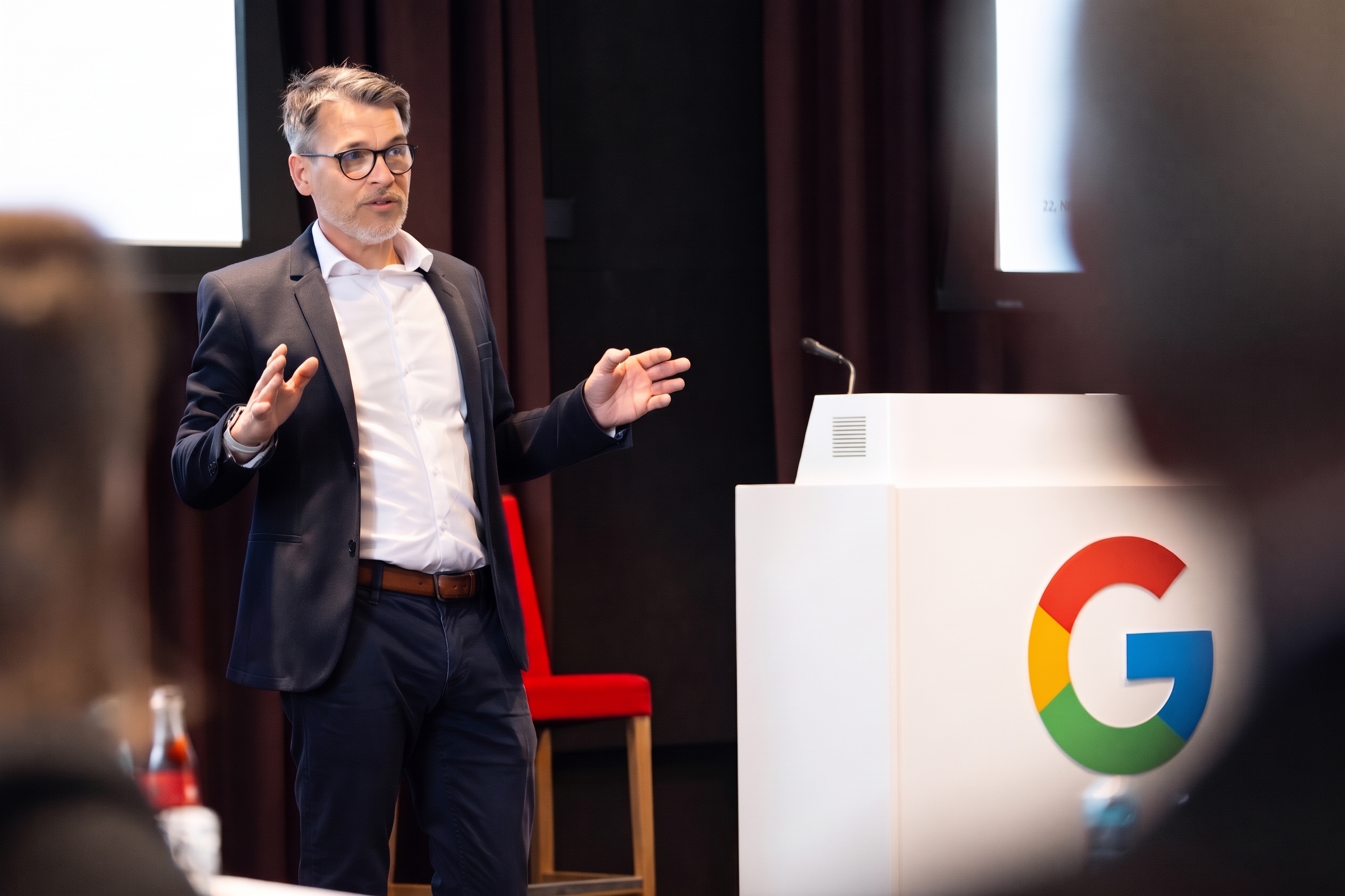
As Germany and Europe navigate geopolitical uncertainty, hybrid cyber threats, and rapid technological change, the debate around digital sovereignty has reached a decisive turning point. In this AmCham Germany Member Story, Michael Neuber, EU Lead Cloud Resilience and AI for Cyberdefence, Google Cloud, explains why true sovereignty depends on open choice rather than isolation, how artificial intelligence (AI) has become essential for both economic growth and national resilience, and why billions in local investment are helping power Germany's next economic miracle.
Digital sovereignty has become a defining topic for German businesses and policymakers. What is the biggest misconception you encounter in these conversations?
The biggest misconception is that digital sovereignty means sealing ourselves off and building everything from scratch. True sovereignty is the freedom to choose and operate securely and resiliently.
Many people still equate cloud sovereignty solely with where a server physically stands. Pure data localization is just a shipping label, not a security guarantee. Storing data inside national borders alone does not protect an organization from ransomware or unauthorized access. Real sovereignty requires technically verifiable control, cryptographic independence, and genuine choice.
In practice, that control rests on Zero-Trust architecture, end-to-end data encryption, and technically verifiable controls such as key access justification and client side encryption, which let customers cryptographically handle, approve or deny every access. Just as importantly, sovereignty means geo redundancy, switchability and preventing vendor lock-in. We eliminate cloud switching fees for customers moving their workloads and champion open-source standards like Kubernetes so European companies keep their architectures interoperable and multi-cloud ready.
Operators of critical infrastructure often worry that strict sovereignty requirements will cut them off from leading-edge innovation. How do you solve that tension?
Critical infrastructure operators in energy, healthcare, finance, and public administration cannot compromise on either resilience or compliance. They need protection against unauthorized access, operational disruption, and vendor lock-in – all at once.
We combine the best of both worlds: our speed of innovation and hyperscale cloud and AI infrastructure with the unmatched expertise of trusted European partners in cybersecurity, encryption, and European defense-grade governance. No local provider alone can replicate multibillion-euro investments in global cloud and AI stacks, and no global provider alone can deliver the local governance footprint of a domestically rooted European operator. We therefore believe in a “Made with Europe” approach.
Through sovereign operating models with independent local partners in Germany, responsibilities remain clear and auditable. We deliver the underlying technology stack, security updates, and frontier AI capabilities, while security-cleared personnel from trusted local partners manage sovereign operations, customer support, and external encryption keys on German soil. Customers gain full alignment with Federal Office for Information Security (BSI) standards like C5 or C3A and Network and Information Security Directive 2 (NIS-2) standards without falling behind the global innovation curve.
Companies often treat AI adoption and cybersecurity as separate priorities. Why do you argue that implementing AI is now essential from both perspectives?
Because the economic opportunity and the security reality are now inseparable, delaying AI adoption creates a double risk.
From a business perspective, a study by Implement Consulting Group estimates that widespread adoption of generative AI could boost the European Union's (EU) gross domestic product (GDP) by €1.2 trillion over a decade, including roughly €440 billion in Germany alone. Facing demographic change and skilled-labor shortages, German companies – especially the Mittelstand – need AI-driven productivity and industrial innovation to remain globally competitive.
At the same time, our latest AI Threat Tracker Report published quarterly by our Google Threat Intelligence Group (GTIG) shows that cyber adversaries are not waiting. Threat actors have moved beyond simple manual prompting to deploying automated exploit engines and autonomous multi-agent frameworks that scan for vulnerabilities and launch attacks far faster than human teams can respond. In an era where adversaries deploy automated exploit engines, defenders must fight AI with AI. Shifting from human-speed to machine-speed defense is no longer optional – it is the only way to protect the digital backbone that Europe's €1.2 trillion AI opportunity depends on.
What concrete threats is your threat intelligence team seeing on the frontlines in Europe today?
Our frontline visibility and attribution capabilities give us a clear view into how state sponsored and hybrid threats are evolving across Europe. GTIG continuously tracks Russian state-sponsored cyber intrusions and hybrid campaigns targeting European critical infrastructure, government institutions, defense supply chains, and digital services.
What makes this moment particularly urgent is speed. As documented in the AI Threat Tracker, threat actors – including Russian-nexus groups – are integrating AI into reconnaissance, localized social engineering, and automated vulnerability exploitation. That compresses the window between a software patch being released and an attacker exploiting an unpatched system. Defending against state-backed adversaries at that tempo requires global threat visibility paired with AI-powered, machine-speed defense – capabilities that no single organization or isolated national silo can build alone.
How do your investments in Germany tie into this vision of a sovereign, secure, and competitive transatlantic economy?
Digital sovereignty and massive investment in Germany are two sides of the same coin: we invest billions in local infrastructure, build sovereign software and operating models with trusted local partners in Germany, and deliver open foundational technologies – so Germany can shape its next economic miracle from a position of strength.
Between 2026 and 2029, we are investing €5.5 billion in Germany to expand our cloud and AI data center capacity in the Rhine-Main region and grow our offices in Berlin, Frankfurt, and Munich. We see ourselves as an enabler, not a gatekeeper. German companies retain 100 percent ownership of their data, models, and intellectual property. When Germany's unmatched engineering excellence combines with open, sovereign cloud and AI infrastructure, transatlantic partnership becomes the engine for Germany's next Wirtschaftswunder.