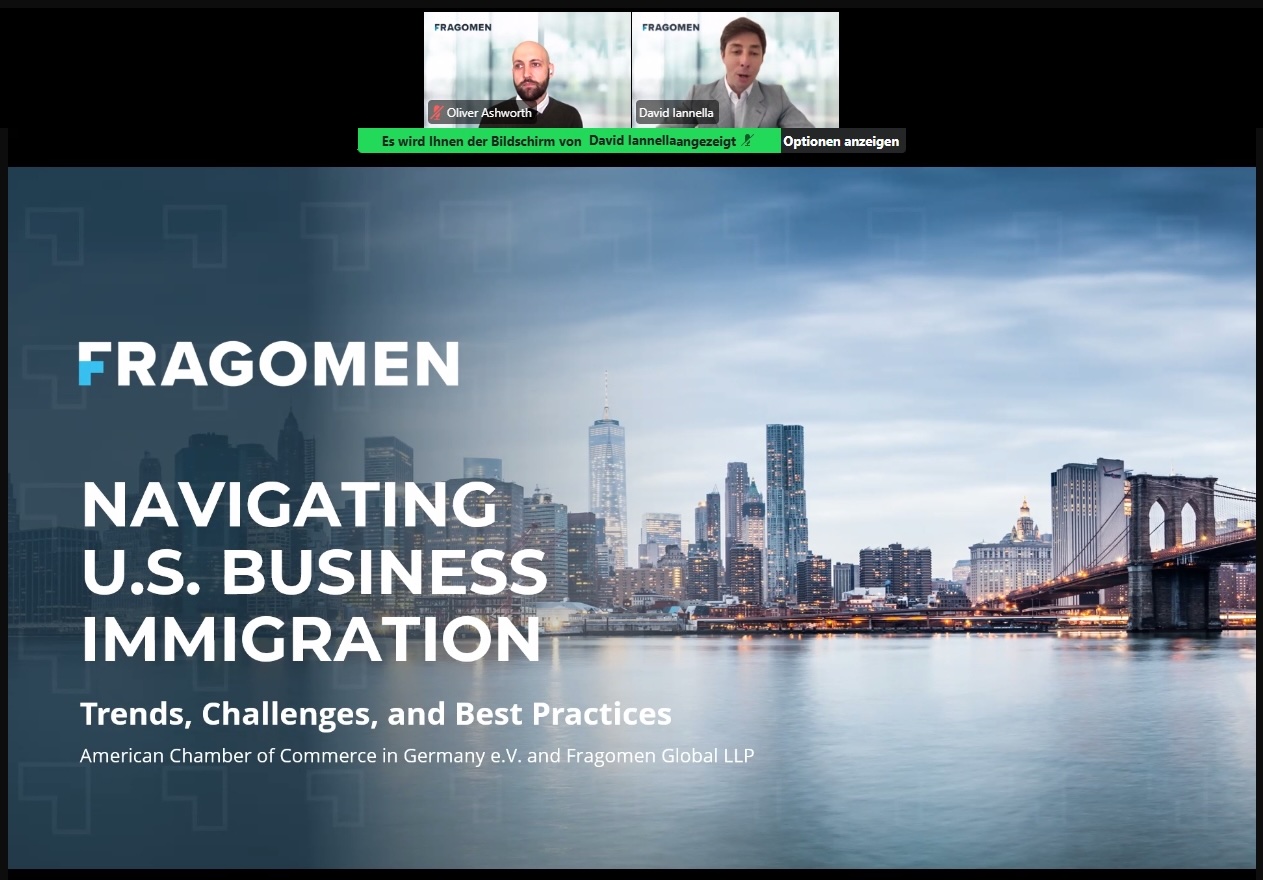
On October 1, 2026, AmCham Germany and Fragomen Global LLP hosted an Expert Webinar on “Navigating U.S. Business Immigration: Trends, Challenges and Best Practices.” The session was led by David Iannella, Director at Fragomen Global LLP, and Oliver Ashworth, Senior Associate at Fragomen Global LLP.
Against a backdrop of evolving U.S. immigration policies and increasing enforcement activity, the webinar provided companies with practical guidance on managing business travel, international assignments and workforce mobility to the United States. The speakers discussed how immigration compliance is increasingly moving beyond the initial visa application and approval process toward ongoing verification, greater information sharing and closer alignment between immigration status and actual employment circumstances.
A particular focus was placed on distinguishing permissible business visitor activities under B-1 and ESTA from activities that may require work authorization. The discussion highlighted that the nature of the activities performed in the United States, rather than job title, payroll location or the duration of a trip alone, is central to the assessment.
The webinar also examined key U.S. immigration routes available to international businesses and their employees, including L-1 intracompany transfers, E-1 and E-2 treaty visas, H-1B visas and O-1 visas, alongside longer-term permanent residence options. For German businesses in particular, the presenters discussed the opportunities offered by E-1 treaty trader and E-2 treaty investor classifications, subject to the relevant nationality, ownership, trade and investment requirements.
Another key message concerned compliance after approval. Employers were encouraged to treat immigration compliance as an ongoing process, monitoring changes in worksite, role, compensation, corporate structure and employment status throughout an assignment.
The session concluded with practical steps companies can take to strengthen their immigration programs, from reviewing frequent B-1 and ESTA travellers and connecting immigration review with recruitment and workforce changes, to centralizing immigration tracking and identifying alternative routes for business-critical assignments.