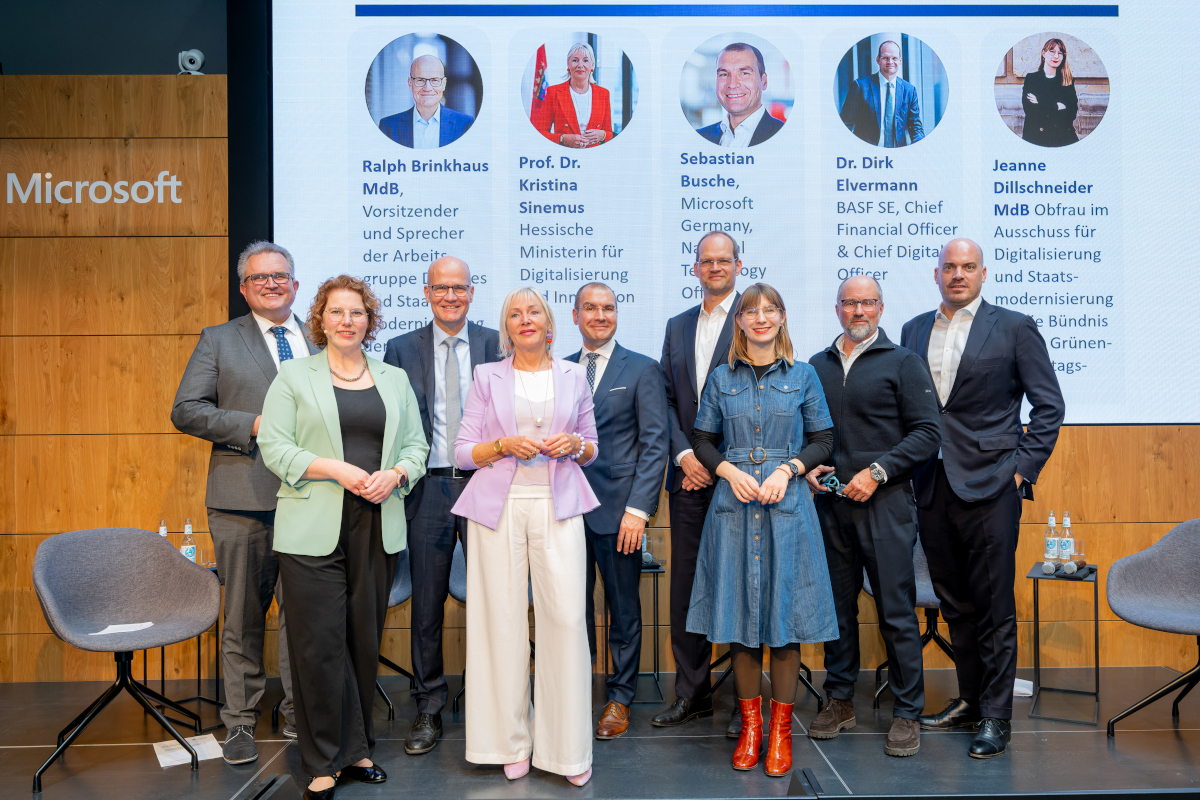
On September 24, 2026 AmCham Germany and the German Chemical Industry Association (VCI) jointly convened representatives from government and industry at Microsoft Germany in Berlin to discuss one of the most pressing questions facing Germany and Europe today: how to strengthen digital sovereignty while enhancing industrial competitiveness in an increasingly interconnected global economy. The event provided a platform for a timely exchange on the role of technology, innovation, and transatlantic cooperation in shaping Europe’s future economic resilience and competitiveness.
The event opened with remarks from Ansgar Baums, Microsoft Germany, who welcomed participants and emphasized the importance of constructive dialogue on the future of digital transformation, competitiveness, and transatlantic cooperation.
This sentiment was continued by Daniel Andrich, AmCham Germany, who framed the broader discussion and emphasized that the key challenge is not whether the next technological transformation will occur, but whether Germany and Europe will actively shape it. He highlighted the need for digital sovereignty that preserves openness and freedom of choice while strengthening the technological capabilities necessary to translate innovation into industrial competitiveness. He further underscored the value of the transatlantic partnership as a catalyst for innovation, growth, and resilience.
On behalf of the event's co-host, Norbert Theihs, VCI, also addressed participants and highlighted the importance of digital transformation for Germany's industrial base and the chemical industry. He stressed that strengthening innovation, competitiveness, and technological capabilities will be critical to ensuring that Germany and Europe remain attractive and resilient industrial locations in an increasingly digital global economy.
A keynote address by Prof. Dr. Kristina Sinemus, Minister for Digitalization and Innovation from Hesse, focused on the foundations of digital sovereignty and the importance of strong technological capabilities, resilient infrastructure, innovation-friendly conditions, and reliable international partnerships. Drawing on Hesse’s role as a leading hub for digital innovation and industrial application, she outlined how regions can contribute to strengthening Europe’s digital future while remaining globally connected.
The second keynote was delivered by Dr. Dirk Elvermann, Chief Financial Officer and Chief Digital Officer, BASF SE, who explored the relationship between digital transformation, industrial competitiveness, and global value chains. He underscored that strategic independence is not achieved through disengagement from international markets, but through maintaining diversified options and choices within them. His remarks highlighted the importance of combining openness with resilience in an increasingly digital and interconnected economy.
Following the keynote speeches, participants engaged in a panel discussion moderated by Nina Keim, Co-Chair, AmCham Germany Digital Policy Committee. The discussion brought together representatives from industry and politics, including Ralph Brinkhaus, Member of the German Bundestag, Sebastian Busche, Microsoft Germany, Jeanne Dillschneider, Member of the German Bundestag, Dr. Dirk Elvermann as well as Prof. Dr. Kristina Sinemus. Panelists explored how Germany and Europe can strengthen digital sovereignty while remaining competitive on a global scale, and discussed the critical role of innovation, investment, and international partnerships in achieving these objectives.
Throughout the event, participants emphasized that digital sovereignty should be understood not as isolation, but as the ability to act independently and maintain freedom of choice in an interconnected global economy. The discussion also underscored that digital transformation must ultimately translate into tangible productivity gains and stronger industrial competitiveness. Many of the perspectives shared by the speakers and panelists reflected the key principles outlined in AmCham Germany’s recent Position Paper on Digital Sovereignty “Digital Sovereignty through Openness”, in particular, the conviction that sovereignty is best achieved through technological capabilities, resilience, and strategic partnerships rather than through protectionism or decoupling. Speakers further stressed that the transatlantic partnership remains a decisive competitive advantage, enabling both sides of the Atlantic to combine strengths, accelerate innovation, and build greater economic resilience.
The event successfully brought together leading voices from business, government, and technology for a substantive dialogue on the future of digital sovereignty, industrial competitiveness, and transatlantic cooperation. AmCham Germany extends its sincere thanks to all speakers, participants, and partners for their valuable contributions. We are especially grateful to VCI for its partnership and to Microsoft Germany for hosting this important discussion in Berlin.