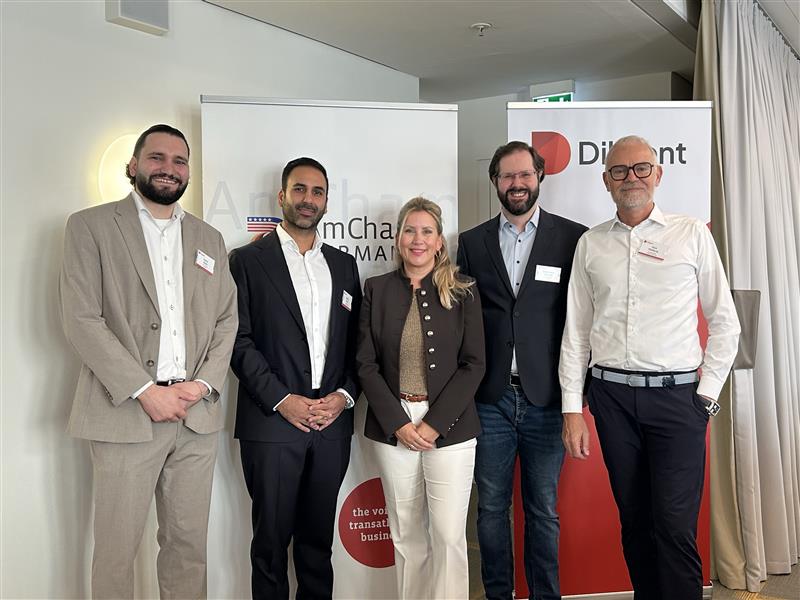
On September 17, 2026, the American Chamber of Commerce in Germany (AmCham Germany), in cooperation with Diligent, hosted an Expert Briefing in Frankfurt am Main bringing together senior business and governance professionals to discuss the challenges and opportunities currently shaping corporate governance.
The discussion focused on the growing impact of artificial intelligence, evolving regulatory requirements and the changing needs of boards and governance professionals. A central theme throughout the briefing was how organizations can build governance processes that provide greater transparency, accountability and oversight while remaining practical for those who rely on them.
Speakers included:
- Gersi Dymi, Account Executive, Diligent
- Dominique Conrad, Solutions Engineer, Diligent
- Damun Kiani, Legal Counsel, Viridium Group
AI is creating new governance questions
Artificial intelligence is creating significant opportunities for organisations, while also introducing new questions around responsibility, oversight and accountability. The discussion explored how organisations can establish appropriate governance structures around AI and ensure that its use is secure, transparent and aligned with organisational objectives.
A particular focus was placed on the need to move beyond fragmented approaches to AI and information management. Rather than relying on disconnected processes, email-based reporting or general-purpose AI tools, organisations are increasingly looking for structured governance frameworks that provide clear ownership, visibility and accountability.
The discussion highlighted that effective AI governance is not solely a technology issue. It also requires clearly defined responsibilities and processes that enable boards and management teams to understand how AI is being used, what risks it presents and where decisions and accountability sit.
Connecting governance, risk and regulation
The briefing also examined the growing number of regulatory requirements affecting organisations across Europe, including NIS2, DORA and the EU Omnibus Package.
As regulatory expectations continue to evolve, organisations face the challenge of managing multiple requirements while maintaining a clear overview of their wider risk landscape. Rather than approaching each regulation in isolation, the discussion highlighted the value of connecting governance, risk and compliance processes.
An integrated approach can help organisations identify responsibilities more clearly, improve transparency and provide decision-makers with a more comprehensive view of risks across the organisation.
Different perspectives on board and governance management
Another key theme was the diversity of needs among the people involved in corporate governance.
Board members, supervisory board members, advisory board members and Corporate Secretaries each have different responsibilities and perspectives. These differences influence how information is prepared, shared and discussed, as well as how decisions are documented and followed up.
The discussion therefore considered how technology can support the wider governance process — from preparing and distributing board materials to facilitating collaboration, improving transparency and enabling more informed decision-making.
Looking ahead
The Expert Briefing highlighted how closely AI, regulation, risk and corporate governance are becoming interconnected. As organisations face increasing regulatory complexity and growing expectations around transparency and accountability, governance processes will need to evolve accordingly.
For boards and management teams, the challenge is not simply to remain compliant. It is to establish governance structures that are secure, transparent, connected and practical, enabling organisations to respond effectively to technological and regulatory change.
The exchange in Frankfurt provided an opportunity to explore these developments from different governance perspectives and highlighted the importance of bringing technology, risk management and corporate governance closer together.