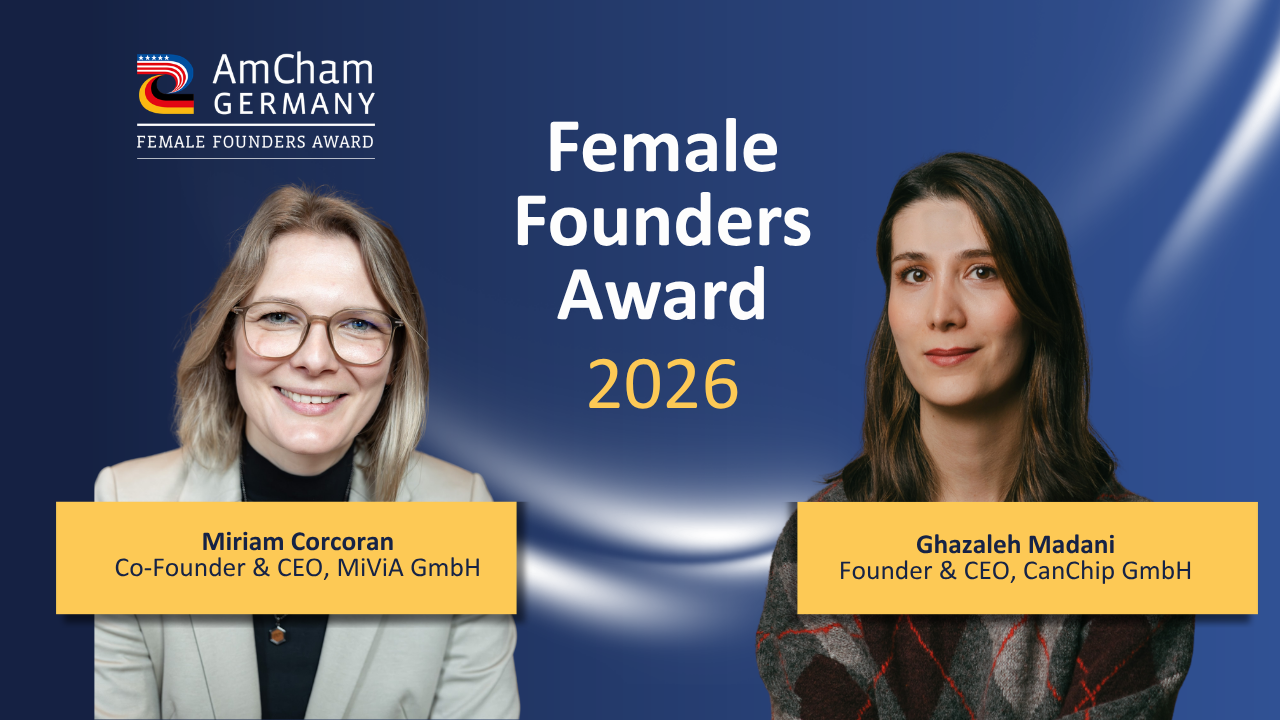
Interview with Miriam Corcoran, Co-Founder & CEO, MiViA GmbH
Q: Can you give us a short overview of how you came to start your own business?
My path into becoming a deep-tech founder was not a traditional one. I started my career in hospitality management and later moved to the UAE, where I gained my first leadership and entrepreneurial experience while helping establish a new business location.
Seeing how a business is built and scaled from the ground up sparked my interest in entrepreneurship and made me realize that I wanted to build a company of my own one day.
As someone with a business background, however, I felt that I lacked a truly innovative technology or product idea.
Therefore, I actively engaged in the entrepreneurial ecosystem at the university and specifically looked for potential co-founders with strong technical expertise.
Through this network, I met researchers working on AI-based microstructure analysis and immediately saw the opportunity to combine scientific innovation with entrepreneurship.
What really convinced me was the combination of a cutting-edge technology and a long-standing industrial challenge.
Microstructure analysis is critical for manufacturing quality, yet it is still largely performed manually.
I saw the opportunity to transform excellent research into a scalable software business that could deliver real value to industry. That became the foundation of MiViA.
Q: What do you think can be done policy-wise to improve the start-up ecosystem in Germany?
Germany has outstanding universities, research institutions and engineering talent.
In my view, the challenge is encouraging more people to turn innovation into companies.
Thinking back to my own time as a student, large corporations were often presented as the default or most attractive career path. Entrepreneurship and startups were much less visible.
As a result, many talented graduates never seriously consider founding a company or joining an early-stage venture.
I believe we need to expose more students and young professionals to entrepreneurship. Starting or joining a startup is one of the fastest ways to learn and develop professionally.
You take on responsibility early, solve real problems and gain experience across many different areas of a business. Few corporate environments offer a comparable learning curve.
We should make entrepreneurship a more visible and attractive career option. The earlier people are exposed to founders, startups and innovation ecosystems, the stronger our entrepreneurial culture will become.
Q: What do you think could be done to promote female founders?
I think we need to change the perception of what it takes to build a successful company.
As a founder in a highly technical industry, I have often found myself in situations where I felt I had to prove my competence repeatedly in order to be taken seriously.
I think many women experience similar challenges and, as a result, may hesitate to pursue entrepreneurship in the first place.
Part of the reason is that entrepreneurship in technology is still often associated primarily with technical expertise. Of course, great technology is essential. But building a successful company requires much more than that. It requires leadership, communication, customer understanding, business development and the ability to turn innovation into real market impact.
These capabilities are sometimes viewed as secondary or "soft skills," when in reality they are just as critical as product development. A great technology without customers, a business model or a strong team will not succeed. The most successful companies are built when technical excellence and entrepreneurial leadership come together.
The more we recognize and value these different forms of expertise equally, the more women will see themselves not only as contributors to innovation, but as founders and leaders capable of building the next generation of technology companies.
Interview with Ghazaleh Madani, Founder & CEO, CanChip GmbH
Q: Can you give us a short overview of how you came to start your own business?
I didn’t start a company just to build a business, I started it to solve a real problem I saw in drug development. Coming from a scientific background, I realized how often promising therapies fail because traditional models, especially animal testing and simplistic cell cultures, don’t accurately predict human outcomes.
Together with my co founders, I saw an opportunity to change that. We founded CanChip to develop human relevant organ on chip systems that generate more reliable data and help researchers make better decisions earlier in the process. The strong early feedback from partners and customers confirmed that we were addressing a critical gap in the market, and that motivated us to fully commit to building the company.
Q: What do you think can be done policy-wise to improve the start-up ecosystem in Germany?
I think Germany already has a very strong foundation with great talent, strong universities, and access to capital. Where we are still lagging is in speed and simplicity.
If I look at it from a founder’s perspective, the biggest lever would be reducing bureaucracy. Setting up a company, dealing with authorities, or applying for funding still takes too long and is often unnecessarily complex. Making these processes faster and fully digital would have an immediate impact.
Another important point is access to talent. Startups need to be able to hire internationally without friction, so faster visa processes and more flexible regulations would help a lot.
In addition, I think public funding programs should be faster and more startup-oriented. The support itself is often strong, but the application processes are slow and complex, which makes them difficult to use in a fast-moving startup environment.
And finally, it’s about mindset. Policymakers should actively encourage entrepreneurship by being faster in decision making and more open to risk. Germany has everything it needs to be a leading startup hub, but it needs to become more founder friendly in practice.
Q: What do you think could be done to promote female founders?
I think there has been a lot of positive momentum in promoting female founders, especially in terms of visibility, awards, and dedicated programs. That’s an important first step, and it definitely helps to inspire more women to start companies.
However, what I see is that the real gap comes afterwards. Once the initial visibility is there, many female founders still face the same structural challenges, but often with less access to networks, follow-on funding, and long-term support.
So in my view, the focus should shift more towards what happens after the promotion phase. That means better access to growth capital, stronger integration into investor networks, and more long-term mentorship and sponsorship.
It’s less about creating more visibility and more about ensuring that female founders can scale their companies under the same conditions and with the same support as everyone else.