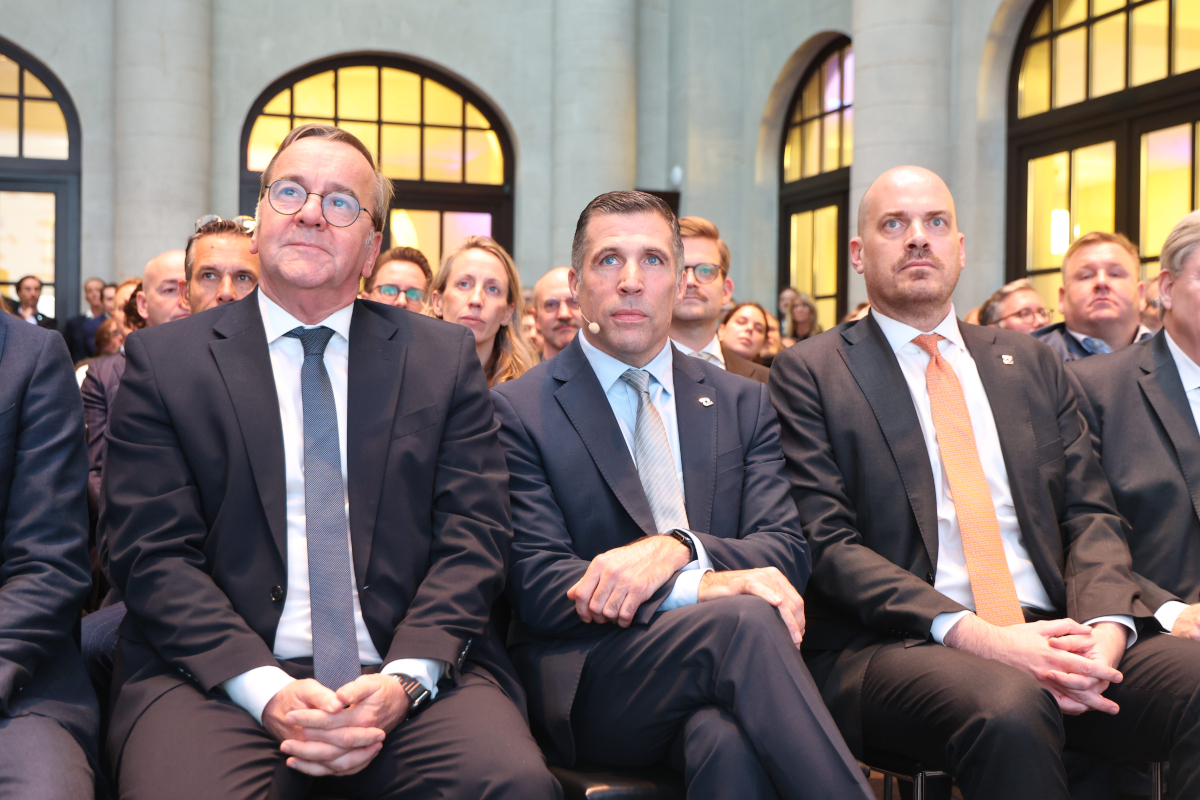
At the 20th Transatlantic Business Conference in Berlin, leaders from business, government, and the transatlantic community came together to discuss the future of transatlantic relations, economic competitiveness, and Germany’s role as a business and investment location. Taking place just two days after the U.S. midterm elections, the conference provided a timely opportunity to assess the political and economic environment shaping cooperation between Europe and the United States.
In his opening remarks, Christopher F. Porter, President of AmCham Germany, highlighted the enduring importance and strategic advantage of the transatlantic partnership in an increasingly complex geopolitical and economic landscape. He emphasized the need for continued dialogue and cooperation between policymakers and business leaders to strengthen growth, innovation, resilience and competitiveness on both sides of the Atlantic.
The opening keynote was delivered by Dr. Markus Kamieth, Chief Executive Officer of BASF SE, who outlined the opportunities and challenges facing the transatlantic economy and underscored the importance of maintaining open markets, fair competition, and strong investment ties between Europe and the United States. Following his keynote, Dr. Kamieth joined Daniel Andrich, General Manager, AmCham Germany, for an exchange on the future of transatlantic economic cooperation and the conditions needed to strengthen long-term growth and resilience.
Participants also gained a U.S. government perspective through a keynote address by Alan Meltzer, Chargé d’Affaires at the U.S. Embassy Berlin, who provided insights into the current state of transatlantic economic relations and highlighted the continued importance of close cooperation between the United States and Germany.
Building on these perspectives, the first panel discussion examined the outlook for the transatlantic economic partnership following the U.S. midterm elections. Moderated by Dr. Andrea Huber, the discussion brought together: Tim Fenton, Vice President, Global Government Relations, Thermo Fisher Scientific; Metin Hakverdi, MdB, Coordinator of Transatlantic Cooperation; Patrick van der Loo, Country President Pfizer Germany, Pfizer Pharma GmbH; Loretta Sanchez, Former Member of the U.S. House of Representatives (1997-2017), and Member of the Board, Association of Former Members of Congress; and Bill Wichterman, Senior Advisor, Covington & Burling.
The panel explored the implications of political developments in both the United States and Europe for trade, investment, economic security, and transatlantic cooperation. Participants emphasized the importance of predictability, cooperation, and the continued need for transatlantic engagement in navigating an increasingly competitive global environment.
A second panel discussion focused on strengthening Germany’s competitiveness as a place to invest, innovate, and do business. Moderated by Gordon Repinski, the panel featured: Rocco Bräuniger, VP & Country Manager, Amazon EU SARL; Ellen Demuth, MdB, Member of the German Bundestag (CDU/CSU), Member of the Committee on Foreign Affairs; Stefan Hefter, Consulting Partner and the Head of Defense for Germany and EMA, KPMG AG Wirtschaftsprüfungsgesellschaft; Christian Thams, Head of Value & Access, Johnson & Johnson Innovative Medicine Germany; and Christoph Weigler, General Manager - Germany, Austria, Switzerland, Uber.
Panelists discussed the policy, economic, and technological factors shaping Germany’s future competitiveness, including its innovation potential, the digital transformation of industries, investment conditions, and the broader regulatory environment. The discussion highlighted the importance of creating framework conditions that enable businesses to invest, grow, and remain globally competitive.
The conference concluded with a keynote address by Federal Minister of Defence Boris Pistorius, followed by a discussion with Christopher F. Porter. The exchange focused on the broader geopolitical and security context shaping transatlantic relations and underscored the critical role and close transatlantic connection for our collective security.
In addition to the keynote speeches and panel discussions, attendees participated in a series of breakout sessions organized by conference partners and sponsors, providing opportunities for more focused exchanges on key industry and policy topics. The conference also served as the occasion for the release of AmCham Germany’s annual rankings of the Top 50 U.S. Companies in Germany by revenue and the Top 30 U.S. Employers in Germany, highlighting the significant contribution of U.S. companies to the German economy (more information here).
The 20th Transatlantic Business Conference once again demonstrated the value of bringing together senior representatives from business and government for a substantive dialogue on the opportunities and challenges facing the transatlantic partnership. Across all keynotes, panels, and discussions, participants emphasized the importance of strengthening competitiveness, fostering innovation, and deepening cooperation to ensure long-term prosperity and resilience on both sides of the Atlantic.
AmCham Germany extends its sincere thanks to all speakers, moderators, partners, sponsors, and participants whose contributions made this milestone conference possible, in particular our cooperation partners: Covington & Burling, Johnson & Johnson, Pfizer Germany and the Transatlantic Business Initiative; our platinum sponsors: Amazon, BASF, Diligent, Fortlane Partners, KPMG, PwC, Thermo Fischer Scientific und UPS; our gold sponsors: Lilly and Lockheed Martin; our silver sponsors: GXO, McDonalds, Noerr, UL Solutions und 3M; our mobility partnerUber; and our media partner POLITICO.
